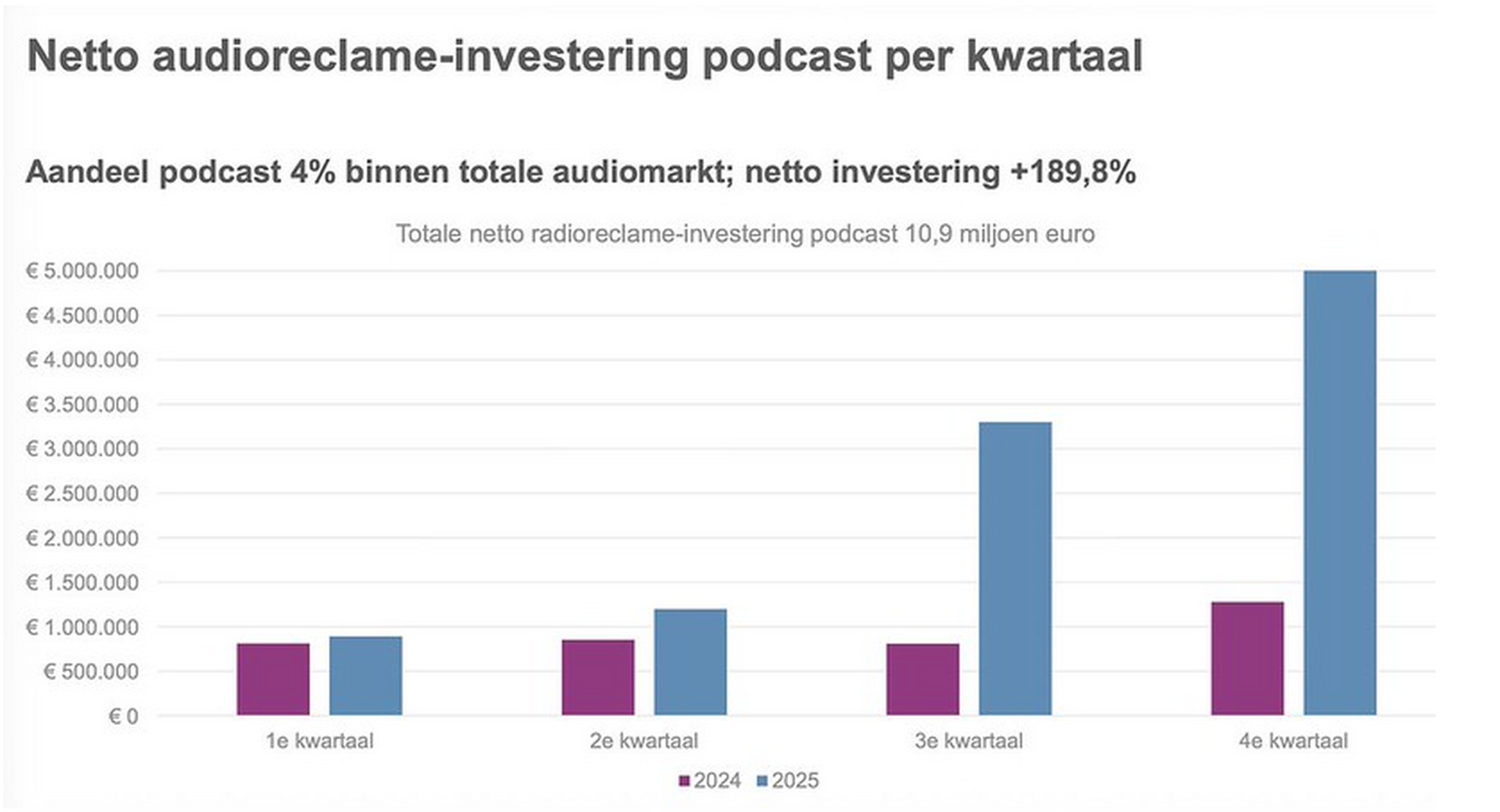
The Dutch podcast market grew to over €11 million in ad spending (Emerce, 2026), where advertisers showed the real growth spurt especially in the last quarters. Globally, the market already passed the $7 billion mark in 2024 (Bloomberg, 2025) and projections for 2030 are already above $130 billion. For advertisers, of course, that is attractive: an audience that listens continuously for 30–45 minutes.
At Mediahuis, with our portfolio of radio stations - from Veronica to SLAM! - we have years of experience with audio advertising. This transition to digital also offers many opportunities at the same time: targeted campaigns, real-time optimization, cross-platform insights. What was simply not possible in traditional radio becomes technically wél feasible in digital audio and podcasts.
But operationally it is still lagging behind.
The infrastructure squeaks and creaks. Protocols such as the IAB's podcast measurement guidelines have existed since 2017 (IAB Tech Lab), but adoption is slow. The problem is not in how we offer podcasts - at Audiohuis, we serve content through Omny Studio (Triton) and use TAP as an ad server, with distribution to every conceivable endpoint.
The problem is in what those endpoints send back. Spotify shares different data than Apple Podcasts. Google Podcasts different again. Each platform has its own definitions, limitations and dashboards.
As Audio House, we act as a podcast network for Media House titles én as a third-party network for outside creators and networks. We make our own productions, productions with partners, and distribute for third parties. Every day we run into this fragmentation: a campaign perfectly tracked through our infrastructure disappears into a black box as soon as it reaches an endpoint.
An advertiser gets three different versions. Completion rates that are not comparable. Reach rates that don't filter out overlap. Frequency caps that apply only within ééone platform. Listener data remains trapped - merging requires manual work. And targeting without cookies or cross-app ID's means coarse contextual data: genre, position, time of day.
For advertisers accustomed to display or video, this is frustrating. Marketing teams expect real-time dashboards and accurate targeting. In podcasts, you get reports that come in a day or later and require manual adjustments.
The industry is working on it. Cross-platform measurement via Triton's Podcast Metrics Ranker (Triton Digital). Better data sharing. More standardization through IAB Tech Lab. Fine initiatives, but the question is when - and whether you can wait that long.
This immaturity offers óók opportunities. At Mediahuis and Audiohuis we notice daily where tools fall short. So we build solutions ourselves where tooling falls short.
We distribute via TAP to Spotify, Apple, Podimo, YouTube and every other platform imaginable. So each of these endpoints measures delivery with its own definitions and its own granularity. For media buyers, this means: manually aggregating data, interpreting it, hoping you're comparing apples to apples.
We built dashboards that aggregate data from these fragmented sources, normalize it to proprietary standards, and make it comparable. Python scripts that read API's, database integration that gives real-time insight. Not rocket science, but it saves hours a week and enables insights for our advertisers that otherwise would not have been easily possible.
And this is just ééone example. So much more is possible to get closer to the rest of the market. Consider: Data enrichment with first-party signals, contextual targeting based on transcript analysis, cross-platform frequency management - the opportunities are there, precisely because standards are not yet fixed and platforms have limited sharing. Room to experiment and build what advertisers need now.
This maturity is coming, but do you want to wait for it as an advertiser? IAB is working on standards. Platforms are investing in better measurement. In two years, the landscape will already be more mature.
But the ad market is not waiting. Budgets are shifting to audio now. Digital radio reach is growing. Podcasts are gaining market share. Advertisers want insight now.
Parties that invest in their own tooling and data infrastructure now will soon be leading the way. They've built data history, learned which signals are predictive, optimized workflows for podcasts. Is that fair? Not necessarily. Publishers with in-house adtech teams have an edge. But the market rewards effectiveness.
The immaturity of podcast advertising is a choice. Get stuck in limited data and wait for platforms to expand their APIs. Or build the tools that bring data together, enrich it, and make it actionable.
Just because data standards are not yet fixed, you can experiment. Precisely because platforms have limited sharing, you create value by building your own solutions. Precisely because targeting and measurement are in their infancy, there is room to differentiate.
In two years, these problems may be solved. But by then, the parties that are already building now will have a two-year head start on lessons learned, optimized data flows, and proven added value.
Podcast advertising feels like pioneering and experimentation, because it is. So take advantage of the space now.